















The Grundium Ocus® 20 sets new standards in digital pathology scanning, designed for speed and efficiency in histology applications.
With a focus on scan speed over higher magnification, the Ocus® 20 is ideal for intraoperative frozen section procedures, allowing pathologists to make quick, reliable diagnoses.
Combining high precision with ease of use, the Ocus® 20 offers an optimal blend of quality and affordability for labs where higher magnification isn’t necessary.
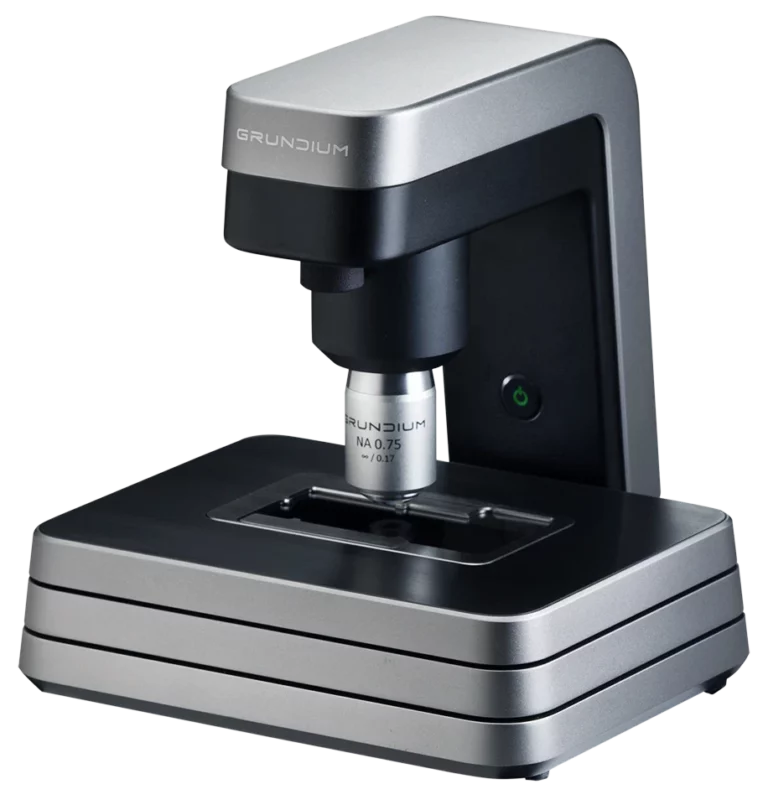
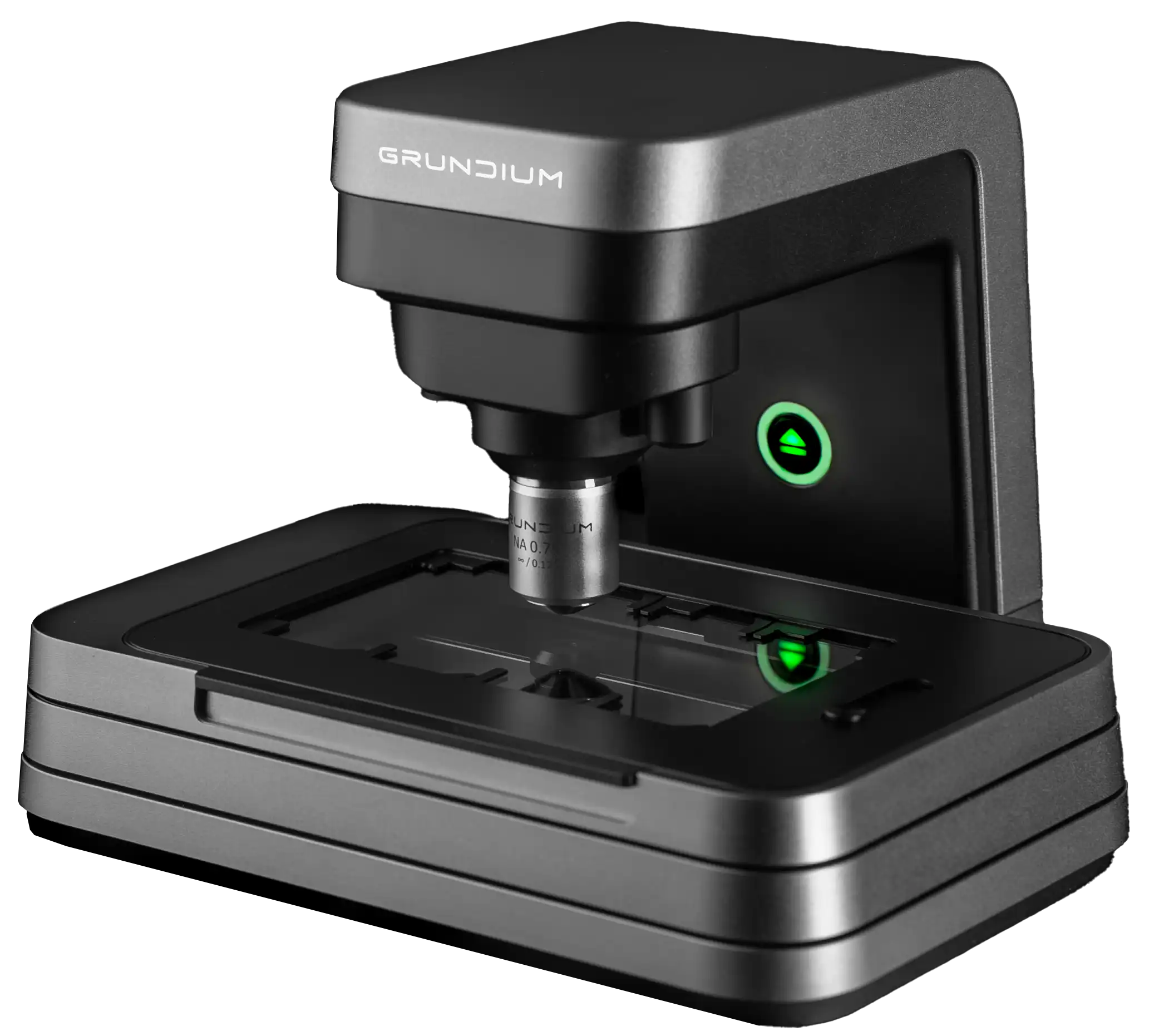
The Ocus® 40, with its powerful 40x magnification, delivers unmatched detail in every scan, making it ideal for cytology and other applications that require high-resolution imaging. For those who need the best image quality, the Ocus® 40 brings the microscopic world into sharp focus.
Engineered for accessibility and performance, the Ocus® 40 combines quality, affordability, and user-friendliness, unlocking new possibilities in digital pathology.
The Ocus® M series devices are Grundium’s most advanced digital pathology scanners, built for high-performance labs. With a larger slide capacity for extended walkaway scanning, and a removable slide tray for easy handling, it streamlines workflows and reduces operator time.
The intuitive, feature-rich interface makes the Ocus® M ideal for cytology and other high-magnification applications, delivering outstanding image quality and flexibility for digital pathology.
The Ocus M comes in two different magnification variants; Ocus M 20 and Ocus M 40.
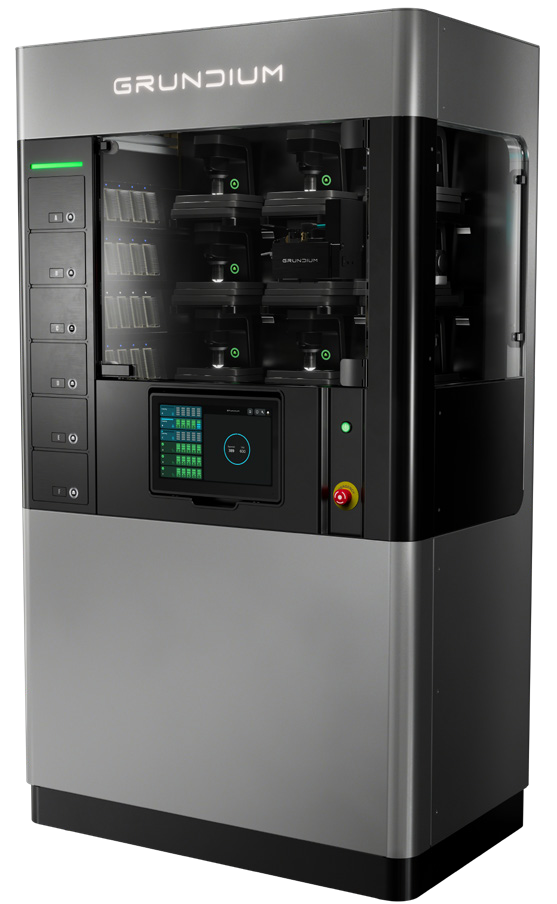
Ocus R brings Grundium’s focus on image quality, compact design and effortless use to high-throughput digital pathology. Its robotic platform combines up to 12 independent scanning heads working in parallel with capacity for up to 600 slides across six automated drawers.
Load-and-go automation minimizes routine user interaction, while continuous loading allows completed drawers to be reloaded without interrupting scanning. Laboratories can add scanning heads as volumes grow without increasing the instrument’s footprint. Built-in scanning-head redundancy keeps your workflow moving even when an individual head is unavailable.



| Specification | Single slideOcus®20 | Single slideOcus®40 | Four slidesOcus®M20 | Four slidesOcus®M40 |
|---|---|---|---|---|
| Best suited to | Frozen sections, intraoperative work, fast-turnaround histology | Cytology, fine needle aspirates, IHC, tumour grading | Frozen sections, intraoperative work, fast-turnaround histology | Cytology, fine needle aspirates, IHC, tumour grading |
| Price | Request a quote | Request a quote | Request a quote | Request a quote |
| Ongoing licence fees | None | None | None | None |
| Slides per load | 1 | 1 | 4 standard, or 2 large | 4 standard, or 2 large |
| Magnification | 20x | 40x | 20x | 40x |
| Numerical aperture | 0.40 | 0.75 | 0.40 | 0.75 |
| Resolution | 0.50 µm/pixel | 0.25 µm/pixel | 0.50 µm/pixel | 0.25 µm/pixel |
| Depth of field | 5 µm | 1 µm | 4.2 µm | 1.3 µm |
| Z-stacking | Up to 5 layers | Up to 5 layers | Up to 7 layers, 1 µm steps | Up to 7 layers, 0.50 µm steps |
| Scan time, 15×15 mm | ~1 minute | ~3 minutes | ~1 minute | ~3 minutes |
| Onboard storage | 500 GB | 500 GB | 2 TB | 2 TB |
| Scans held, 2×2 cm slides | 500–600 | 250–300 | ~2000 | ~1000 |
| Simultaneous viewers | Up to 8 | Up to 8 | Up to 8 | Up to 8 |
| Footprint | 7 × 7 × 7.5 in 18 × 18 × 19 cm | 7 × 7 × 7.5 in 18 × 18 × 19 cm | 8 × 10.3 × 9.2 in 20 × 26 × 24 cm | 8 × 10.3 × 9.2 in 20 × 26 × 24 cm |
| Weight | 7.7 lbs / 3.5 kg | 7.7 lbs / 3.5 kg | 12.9 lbs / 5.9 kg | 12.9 lbs / 5.9 kg |
| Get a quoteOcus®20 details | Get a quoteOcus®40 details | Get a quoteM series details | Get a quoteM series details |
All Ocus® scanners are browser-based, require no dedicated workstation, and carry no ongoing licence fees. Not sure which model fits your workflow? Book a 30-minute demo and we will talk it through.
Ocus scanners digitize prepared microscope slides using brightfield imaging. The portfolio includes single-slide scanners, four-slide models and a robotic system designed for higher-volume laboratories. Model selection depends on the specimens, image resolution, slide volume and workflow requirements.
Histology and frozen sections. Ocus 20 and Ocus M 20 provide 20× imaging at 0.50 µm/pixel. They support histology applications where this resolution is appropriate, including frozen-section workflows. Digitized slides can be viewed remotely, allowing colleagues at different locations to review images when network access and permissions are in place.
Cytology and detailed tissue review. Ocus 40 and Ocus M 40 provide 40× imaging at 0.25 µm/pixel for applications requiring finer image detail, including cytology and histology. The Ocus M Series also supports Z-stacking, capturing multiple focal planes for specimens that require imaging at different depths.
Single-slide and multi-slide workflows. Ocus 20 and Ocus 40 scan one slide at a time and each weigh 3.5 kg. The Ocus M Series accommodates up to four standard slides in a removable tray, allowing several slides to be scanned without reloading between each slide.
Remote consultation, research and teaching. Ocus 20, Ocus 40 and the Ocus M Series support browser-based image viewing and live microscopy. Images can be reviewed with remote colleagues, used in teaching or exported for use with compatible research and analysis software.
Higher-volume slide scanning. Ocus R accommodates up to 600 slides across six automated drawers and uses up to 12 independent scanning heads in parallel. Completed drawers can be reloaded while scanning continues. Scanned images are transferred to an external image management system.
A digital pathology workflow connects slide preparation, scanning, image access and downstream review or analysis. The scanner captures the images; the selected model and surrounding software determine how those images are stored, shared and used.
Scanning and image access. Ocus 20, Ocus 40 and the Ocus M Series include onboard storage and browser-based viewing. Ocus R is designed to transfer images into the laboratory’s image management environment.
Software and integration. Image management, laboratory information management and image analysis are separate functions. Compatibility with external systems depends on the scanner’s supported image formats and the receiving software’s integration requirements.
Selecting a configuration. Consider specimen preparation, slide dimensions, required resolution, daily slide volume and how users will access the images. Grundium can help identify relevant models and assess integration requirements.
Clinical use and availability. Intended use depends on the device version and market. CE-marked IVDR versions of Ocus 20, Ocus 40 and the Ocus M Series are available for diagnostic use within their intended purpose in the European Union. In the United States, these models are for research use only and not for diagnostic procedures. For current Ocus R availability and regional regulatory information, contact us.

Out of all the scanners I’ve used — and I’ve used a lot — it’s the easiest one. We've scanned more than 30 000 slides without any technical issues.

With Grundium Ocus-enabled telepathology, we can provide better service to our customers; the hospitals. For the hospitals the process doesn’t change, but they benefit from Fimlab working faster and more accurately with digital pathology.

Not only has Grundium created something unique in the market with the beautifully designed small-footprint scanner, but they also have a super technical team that can work really close together to make the whole solution seamless and is willing to invest themselves in making something new. It’s super unique in the world to have everything from the region of interest, focus layers, depth of field and the whole experience totally integrated.

The Ocus scanner is small and produces very sharp images fast. It is a vital instrument in field use in organ procurement. Its unparalleled portability helps save lives.

We have excellent images with the Ocus and I couldn’t be happier to have this little helper on my desk here. I use it mainly as a microscope, to be honest, but of course, scan my slides as well. It has really helped me so much.

The Philips IntelliSite Digital Pathology Solution has the capabilities to upload, view and annotate the images produced from the Grundium scanner. Zooming and panning is really fast, even when the images are physically stored on a server in the Netherlands and I’m viewing the images from a workstation in Sweden.
Discover how Grundium’s digital pathology scanners can enhance your workflow.
Request a demo or send us a message below.
When selecting a microscope slide scanner for pathology workflows, important considerations include image quality, magnification, scanning speed, workflow compatibility, slide capacity, supported file formats, and ease of use. The Grundium Ocus® series provides flexible, browser-based digital pathology solutions ranging from compact single-slide systems to four-slide Ocus® M Series scanners for workflows that benefit from additional walk-away capacity.
Yes. The Grundium Ocus® series supports whole slide imaging by digitizing microscope slides into high-resolution digital images that can be viewed, navigated, exported, and shared. This supports digital pathology workflows across applicable clinical, research, education, and collaborative review environments.
Ocus® digital pathology scanners enable digitized slides to be viewed, navigated, and shared remotely through a web browser without additional viewing software. This supports remote consultations, second opinions, multi-site collaboration, and flexible pathology workflows while helping reduce the need to transport physical slides between locations.
The Ocus®20 and Ocus®40 are compact single-slide digital pathology scanners designed for efficient and accessible slide digitization. The Ocus®20 offers 20x magnification and fast scanning for histology-oriented workflows, including frozen section and intraoperative consultation use cases where speed is important. The Ocus®40 offers 40x magnification for workflows that require higher-resolution imaging, including cytology and detailed cellular review.
The Ocus® M Series adds four-slide capacity and a removable slide tray for laboratories that need additional walk-away scanning capacity or routinely handle multiple slides per case. It maintains the compact, browser-based design philosophy of the Ocus® platform while adding multi-slide workflow features. The Ocus M series is available in both 20x and 40x magnification.
The Ocus®40 and Ocus® M 40 are designed for workflows that require high-resolution digital imaging and detailed cellular visualization. With 40x magnification and 0.25 µm/pixel scan resolution, they are well suited for cytology and other applications where fine detail is important for review, collaboration, and digital pathology workflows.
The Ocus®20 is designed for fast and efficient histology workflows where rapid access to digital slides is important. Its 20x magnification, 0.50 µm/pixel scan resolution, and approximately one-minute scan time for a 15 × 15 mm area make it well suited for histology-oriented applications such as frozen sections and intraoperative consultation workflows where higher magnification is not always required.
The price depends on the model, configuration, accessories, services and purchasing market. The Ocus range includes single-slide scanners, four-slide Ocus M models and the configurable Ocus R system for larger volumes. Share your application, expected slide volume and location so we can prepare a relevant quotation. When planning your investment, also consider any image management, storage, integration and support requirements. Contact us for model-specific pricing and commercial terms.
A digital microscope typically provides a live view of a selected field. A whole slide scanner captures the specimen area as a digital image that can be navigated, stored and shared. Ocus 20, Ocus 40 and the Ocus M Series support both live viewing and scanning. Ocus R is designed for automated scanning into an external image management environment. The choice depends on whether you need live examination, stored images or both.
Ocus scanners provide image capture. Ocus 20, Ocus 40 and the Ocus M Series also include onboard storage and browser-based viewing. Ocus R transfers images to an external image management system. A wider digital pathology deployment may also require case management, long-term storage, connections to a laboratory information system and analysis software. Tell us which systems you use so we can discuss the relevant image formats and integration requirements.
Yes. Ocus 20 and Ocus M 20 provide 20× imaging at 0.50 µm/pixel; Ocus 40 and Ocus M 40 provide 40× imaging at 0.25 µm/pixel. The published scan time for the 20× models is approximately one minute for a 15 × 15 mm area, with actual timing depending on the specimen and scan settings. Ocus R supports automated scanning of larger volumes of prepared histology slides. Choose the model and imaging settings for the sample, review requirements and applicable intended use.
Whole slide imaging is the process of digitising the specimen area on a glass slide at high resolution. Virtual microscopy describes navigating and magnifying digital slide images on screen. The terms refer to related parts of the workflow: a scanner captures the image, and a compatible viewer lets you explore it. Ocus 20, Ocus 40 and the Ocus M Series include browser-based viewing, while Ocus R transfers images to an external image management system.
Ocus 20 and Ocus 40 each hold one standard slide. Ocus M 20 and Ocus M 40 hold four standard 1 × 3 inch slides, or two 2 × 3 inch slides with the appropriate tray. Ocus R holds up to 600 slides in six drawers, with up to 12 scanning heads working in parallel. Heads can be added as volumes grow, up to 12 within the same instrument. Loading capacity describes how many slides the system holds; actual scanning throughput depends on the configuration, specimens and scan requirements.


