

How does a trained cabinetmaker end up as a precision mechanic in digital pathology? Juuso Viljanen found his way to Grundium almost by chance, but a role combining hands-on work, precision, and problem-solving quickly proved to be the right fit. Today, he also trains colleagues in every stage of the assembly process and contributes to the prototyping of new products on the production floor.
I'm Juuso Viljanen, originally from Savonia and now I live in Tampere. I work as a precision mechanic in Grundium's microscope scanner assembly team. I'm trained as a cabinetmaker, although I have never actually worked in that field. Over the years, I have worked at a door and window factory, in the shipping department of a rock-crusher factory, as a CNC machinist, at a coffee roastery, as a vehicle outfitter, and even spent one summer at the Särkänniemi Dolphinarium.
I ended up at Grundium almost by chance. I got to know someone who worked here, and they mentioned that Grundium was looking for precision mechanics. I had heard good things about the team, and the role itself sounded like something I would genuinely enjoy. Hands-on work and tasks that demand precision and care have always appealed to me. I'm a maker through and through, and even in my free time I like working on all kinds of things with my hands. I sent in my application that very evening.
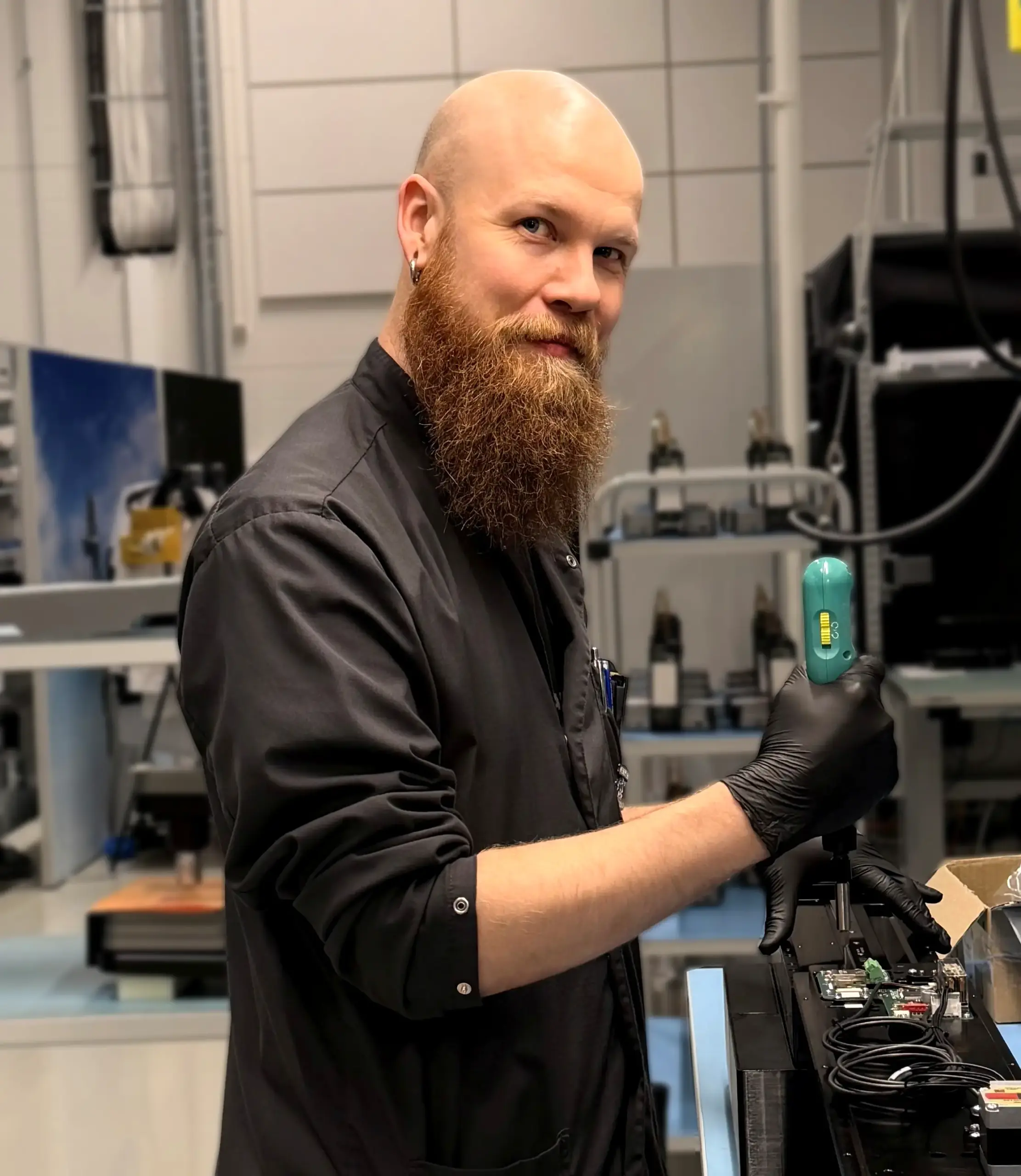
Varied, responsible, and interesting.
Varied because a workweek can include many different tasks, and you do not always know in advance what will come up.
Responsible because I train our assembly employees, so I need to make sure everyone knows what to do and how to do it. I am responsible for training every assembly task and stage of the process.
Interesting because I have had the chance to be involved in many different things. The prototyping stages of new products in particular bring all kinds of situations, so there is never a dull moment. I solve problems almost every day, and that keeps the work engaging and motivating.
I was surprised by how well organized the work is. The production line is clear and divided into eight workstations, each with its own stage of the process. Every stage has excellent work instructions. The team is also highly skilled and genuinely great to work with.
No two days are quite the same. I often start by checking email and Slack and finishing anything left over from the previous day. I may use the morning for tasks that require more concentration, because the factory is at its quietest then. My final task is usually something related to assembly. But in many cases, you simply do not know in advance what the day will bring.
When new devices are moving into production, problem-solving may involve improving work instructions and optimizing the assembly sequence or individual process steps. I also work on issues related to factory safety in my role as the health and safety representative for production. With new products, for example, we assess requirements for protective equipment and electrical safety.
They can see it either directly or indirectly. I may have assembled the entire device, built some of its subassemblies, or trained the colleague who assembled it. Without the assembly team's work, the customer might receive little more than a picture and a pile of 'LEGO pieces' to put together themselves. Once the product has been assembled, our colleagues test it to make sure the customer receives a fully functioning device. If testing reveals any issue, it is fixed. Quality is extremely important to us.
Every new product teaches me something. Each new skill builds on what I have already learned, and I can apply that knowledge in the future. This role has required a different level of precision from my previous jobs.
I had never served as a health and safety representative before, so that role has involved continuous learning. My goal has been to learn as many production tasks as possible and build a broad understanding of the whole process
Very much so. At first, my work consisted of a wide range of assembly tasks. Then I had the opportunity to take on a training role. As new products have been introduced, I have also become involved in the prototyping stages, where we develop work instructions and evaluate assembly solutions.
Knowing that I have reached my goals and done what needed to be done. I also get a sense of achievement from overcoming challenges, solving problems, and being able to help others.
When we manage to complete a product or part of it under a tight deadline, even when it has sometimes felt almost impossible. It is rewarding to see the team reach the goal together.
I can suggest improvements to tools and working methods. As the health and safety representative, I also help shape workplace safety and employee well-being. For example, I played a major role in preparing the safety guidelines for our new production facilities.
Flexible working hours are one of the most important things. Our flexible-hours model allows everyone to adapt their workday to suit their daily life. Other benefits that support well-being include ePassi, EGE events (our shared personnel events), team evenings, the snack cupboard, and summer and Christmas parties.
Fair - Everyone has the opportunity to make their voice heard.
Community-minded - EGE events and other shared activities bring people together.
Innovative - We do not rely on a single product; we are constantly developing something new.
Ambitious - We set our sights high and aim for outstanding quality and products.
Assembly work is not a good fit for someone who wants to do everything entirely their own way without following instructions, or who prefers to avoid hands-on work.
It is easy to become part of both the work and the team. There is a real can-do spirit here, and no one has to solve problems alone. The work is clean, enjoyable, and meaningful, and it offers a unique window into the world of medicine.
Someone will thrive here if they are comfortable being themselves and give others the same freedom, value precision and care, enjoy hands-on work, and like solving the challenges that come with product development. Strong problem-solving skills are important.


